B.Voc in Solar Technology

- Description
- FAQ
- Notice
- Reviews
B.Voc in Solar Technology
The B.Voc in Solar Technology is a specialized undergraduate program designed to equip students with the knowledge and practical skills required to excel in the growing solar energy sector. This comprehensive, industry-relevant course emphasizes both technical and business aspects, preparing graduates to meet the evolving needs of the renewable energy industry.
The program integrates core concepts of solar energy systems, sustainable practices, and entrepreneurship. Students gain hands-on experience through laboratory training, real-world projects, and internships, ensuring they are job-ready from day one.
Admission Notice – B.Voc in Solar Technology for the academic year 2024-25.
IISE is offering B.Voc in Solar Technology for the academic year 2024-25. This course is specifically designed for working professionals in the solar sector who are looking to upgrade their skills & profile as per the latest industry standards.
- Skill based learning
- 200 Hrs. On job training (OJT) in each semester
- 70% Practical and 30% Theory Classes
- Carrier Opportunities
Program Structure – B.Voc in Solar Energy
Intake : 30 Seats
Eligibility
- Passed 12th class examination with Science and Mathematics or its equivalent
- HSC/ 12th – Stream (Science/Commerce/ Arts/Vocational)
- Preference will be given to candidates working in the Solar Sector/ Related energy sector.
Duration: 3 Years (6 Semesters)
Credits: 180
Exit Options:
Certificate: After 1 Year
Diploma: After 2 Years
B.Voc Degree: After 3 Years
Learning Objectives for B.Voc in Solar Technology
By the end of the B.Voc in Solar Energy Technology program, students will be able to:
1. Technical Competency in Solar Energy Systems
- Understand the fundamentals of solar energy and its applications in different sectors.
- Design, install, operate, and maintain solar photovoltaic (PV) and thermal systems.
- Apply knowledge of energy storage technologies, smart grids, and hybrid systems.
2. Practical and Hands-on Skills
- Perform site assessments and system sizing for solar installations.
- Conduct energy audits and evaluate the performance of solar systems.
- Use industry-standard tools, software, and equipment for system design and monitoring.
3. Business Acumen and Entrepreneurship
- Develop business models, feasibility studies, and financial plans for solar projects.
- Understand government policies, incentives, and regulatory frameworks in the renewable energy sector.
- Identify market opportunities and launch entrepreneurial ventures in solar energy.
4. Sustainable Practices and Environmental Awareness
- Analyze the environmental impact of solar energy projects and advocate sustainable practices.
- Understand the role of solar energy in addressing climate change and reducing carbon footprints.
5. Problem-solving and Innovation
- Troubleshoot common issues in solar PV systems and recommend solutions.
- Leverage IoT, automation, and innovative technologies for smart energy solutions.
6. Industry Exposure and Employability Skills
- Apply learning through internships, industry projects, and real-world case studies.
- Develop teamwork, leadership, and communication skills for professional success.
- Stay updated on global trends and advancements in the renewable energy sector.
7. Lifelong Learning and Continuous Improvement
- Cultivate an attitude of lifelong learning to adapt to emerging technologies and challenges.
- Pursue further studies or certifications to stay competitive in the renewable energy market.
Program Highlights – B.Voc in Solar Energy
Hybrid Learning Model:
A blend of online theory sessions with on-site practical training.
Industry Exposure:
Internships and projects with leading companies in the renewable energy sector.
Hands-on Learning:
Experience with solar PV systems, installation, maintenance, and energy audits.
Entrepreneurship Modules:
Business skills to support students in launching their own ventures.
The proposed topics covered are
Year 1 (Certificate Level) – Introduction to Solar Energy
Focus: Basic understanding of renewable energy, solar principles, and introductory technical skills.
Semester 1
Introduction to Renewable Energy (4 Credits)
- Energy sources and sustainability
- Overview of solar, wind, hydro, and bio-energy
- Global and Indian energy policies
Fundamentals of Electricity & Electronics (5 Credits)
- Basics of AC/DC circuits
- Batteries, inverters, and electrical components
- Safety protocols
Basics of Solar Energy (4 Credits)
- Solar radiation and its measurement
- Solar energy technologies: PV and Thermal
Technical Drawing & CAD Basics (3 Credits)
- Introduction to technical drawings
- Basics of CAD for solar design
Practical Lab – Introduction to Solar Components (4 Credits)
- Hands-on sessions with panels, inverters, and batteries
- Basic installation and wiring
Soft Skills and Communication (3 Credits)
- Business communication
- Teamwork and leadership
Semester 2
Solar PV Technology – Basics (5 Credits)
- PV cell structure and types
- Solar panels: Monocrystalline vs. Polycrystalline
- Solar system configurations (off-grid and on-grid)
Electrical Safety & Standards (4 Credits)
- Installation safety standards (IEC, BIS)
- Personal protective equipment (PPE) usage
Energy Economics & Environmental Impact (3 Credits)
- Energy consumption trends
- Cost-benefit analysis of solar systems
Mini Project – Design of Small Solar System (4 Credits)
- Designing a small home-based PV system
Internship (3 Credits)
- Industry exposure: 2-4 weeks at a solar installation site
Year 2 (Diploma Level)
– Intermediate Solar Technologies & Business Concepts
Focus: Skill-building in solar PV installation, maintenance, and system design with exposure to hybrid technologies.
Semester 3
Advanced Solar PV System Design (6 Credits)
- System sizing and load calculation
- PV design software (PVSyst, Helioscope)
Hybrid Solar Systems (5 Credits)
- Solar-diesel and solar-wind hybrid systems
- Battery management systems
Installation and Maintenance of Solar Systems (5 Credits)
- Practical aspects of installation
- System troubleshooting and diagnostics
Power Electronics for Solar Applications (4 Credits)
- Inverters, charge controllers, and converters
Entrepreneurship Development (3 Credits)
- Basics of entrepreneurship
- Business models for solar startups
Semester 4
Solar Thermal Technology (4 Credits)
- Solar water heaters and concentrators
- Applications in agriculture and industry
Grid-Tied Solar Systems (5 Credits)
- Net metering and grid integration
- Government policies and subsidies
Energy Storage Systems (4 Credits)
- Lithium-ion and other battery technologies
- Emerging storage solutions (flow batteries, hydrogen)
Financial Modeling for Solar Projects (4 Credits)
- Project financing and cash flow management
- Feasibility studies
Mid-Level Project – 2kW System Design & Installation (5 Credits)
- Design, procurement, and installation of a 2kW solar system
Internship (4 Credits)
- Industry internship: Hands-on exposure with solar companies (4-6 weeks)
Year 3 (Degree Level)
– Advanced Topics & Project Management
Focus: Specialized knowledge, entrepreneurship, and solar project management with real-world implementation experience.
Semester 5
Solar Grid Integration & Smart Grids (6 Credits)
- Solar in microgrids and smart grids
- Energy management systems
Project Management for Solar Projects (5 Credits)
- Planning, scheduling, and resource management
- Use of project management tools (MS Project, Primavera)
Marketing & Sales of Solar Solutions (4 Credits)
- Customer segmentation and market trends
- Sales techniques and customer relationship management (CRM)
Legal & Regulatory Aspects (4 Credits)
- Government policies, schemes, and subsidies
- Environmental regulations
Capstone Project Proposal (3 Credits)
- Proposal writing for a large-scale solar project
Semester 6
Emerging Technologies in Solar (5 Credits)
- BIPV (Building-Integrated PV)
- Floating solar and Agrivoltaics
- AI and IoT in solar systems
Business Plan Development (4 Credits)
- Writing a business plan for a solar startup
- Identifying funding sources
Capstone Project – Solar Plant Installation & Management (6 Credits)
- End-to-end management of a small solar installation (5-10kW)
Green Entrepreneurship & Sustainable Practices (4 Credits)
- Business models for sustainability
- Circular economy concepts
Placement Preparation & Career Guidance (3 Credits)
- Resume writing and interview preparation
- Industry interactions and guest lectures
Final Internship / Apprenticeship (6 Credits)
- 8-12 weeks with leading solar companies or project developers.
Admission Notice – B.Voc in Solar Technology for the academic year 2024-25.
Admission for this course will be conducted in TWO PHASES for the convenience of International and upcountry students.
Please note that ONCE SEATS ARE FILLED IN THE FIRST PHASE, ADMISSION FOR THE SECOND PHASE WILL NOT BE HELD.
FIRST PHASE:
- Online application start date: 04th December 2024
- Last date for application for the first phase is 16th December 2024.
PROGRAM FEES : Rs. 59,999/-
SCHOLARSHIP:
- Get scholarship up to 35% if you apply before 14th December 2024.
- Total course fee for students availing 35% scholarship is Rs. 39,999/-
- Scholarship consideration is exclusive to applications received by 14th December 2024
- Only 10 seats are reserved for scholarship recipients, allocated on a first-come, first-served basis scoring more than 80% in the online exam.
Applications submitted after 14th December 2024 will not be eligible for scholarship consideration.
Please note that once all scholarship seats are filled during the initial round of admissions, no further scholarship opportunities will be available.
To qualify for the scholarship, applicants must demonstrate exceptional academic performance, scoring at least above 80% in our online test. With scholarships available for 10 deserving students, competition will be fierce – so make sure you’re ready to shine!
SECOND PHASE:
- Online application start date: To be Announced
- The last date for application is To be Announced
- The last Date for Admission is To be Announced
Selection will be strictly on Merit. Seats are limited so students would be shortlisted on first cum first serve basis depending upon qualifications experience & online exam grading.
Admission to this course will be conducted in TWO PHASES. If the seats are filled in the FIRST PHASE. Then the SECOND PHASE of admission won’t be held.
HOW TO GET STARTED – Admission procedure:
Step one:
Admission for the B.Voc start on 04th December 2024
All the students in our inquiry database will be emailed first and given a chance to take admission on a first come first basis.
Course Application fees:
For Indian Citizens / Indians Overseas
If you are interested in the course, please make the payment of Rs 999/ – for the course application – Payment Link
After you make the payment. you will be directed to the application page. Here you can submit all your details. Additional documents if required should be submitted. You will be provided a link for the online exam. The screening committee will then shortlist the eligible candidates.
Shortlisted candidates will be emailed a conditional offer letter . Admission confirmation fee should be paid at this stage as per the fee schedule given by IISE.
Application received on or before 14th December 2024 will be only considered for scholarship.
For Foreign Nationals:
If you are interested in the course, please make the payment of USD 40/
Payment link for the course application ( Please note below the payment button is only for overseas students / Foreign nationals only. )
After you make the payment. you will be directed to the application page. Here you can submit all your details.
Payment by monthly EMI
Now pay your fees in Easy EMI
Students can also pay the fees through interest free Easy Monthly Instalments.
Job Placement Assistance:
We have a dedicated job placement cell for our students. IISE students are recognized through out the solar industry for B.Voc in Solar. The Solar sector is constantly looking to fill up the Engineer/ Technician roles who has successfully completed the Solar course .
To know more Please check the FAQ Tab on this page.
If you are interested in the course, please make the payment of Rs 999/ – for the course application – Payment Link
Course Equivalency :
This course is equivalent to following courses below.
B.Voc in Solar Technology, B.Voc in Solar Energy, b voc full form bachelor of vocation, b voc, bvoc, b voc course, bvoc course, b voc course details, b voc means
To know more Please check the FAQ Tab on this page.
If you are interested in the course, please make the payment of Rs 999/ – for the course application – Payment Link
IISE reserve the right to change the curriculum as per instructions from its Education sub -committee.
We ensure the solar Engineers/ Technicians are equipped with the know how and best practices to install solar plants, which provides end customers with an assurance that they will receive a high-quality installation. The tailored certification training puts you at the forefront of best practices.
On successful completion of the module, you will be able to
Those completing B.Voc in Solar Technology can find employment in the Solar startups, MNC’s, voluntary agencies and other solar organizations.
The information above reflects the currently intended course structure and module details. Updates may be made on an annual basis and revised details will be published through Program Specifications ahead of each academic year. The regulations governing this course are available on our website.
Assessment Structure
- Theory Exams: 50%
- Practical Assignments & Projects: 30%
- Internship Reports & Viva: 10%
- Attendance & Participation: 10%
Learning Outcomes
By the end of the program, students will be able to:
- Design, install, and maintain solar PV and hybrid systems.
- Manage solar projects from concept to commissioning.
- Understand government policies and market trends in renewable energy.
- Develop business plans and pursue entrepreneurship opportunities in the solar sector.
Career Prospects
Graduates will be prepared for roles such as:
- Solar PV System Designer
- Project Manager
- Technical Sales Engineer
- Energy Auditor
- Solar Entrepreneur
Join our Whatsapp Channel

FEE ONLINE PAYMENT by NEFT. Details are enclosed below.
NEFT favoring
INDIAN INSTITUTE OF SOLAR ENERGY
Current Account No.: 000412100071051
Bank Name: BHARAT BANK
Branch: CHEMBUR – MUMBAI
IFSC: BCBM0000005
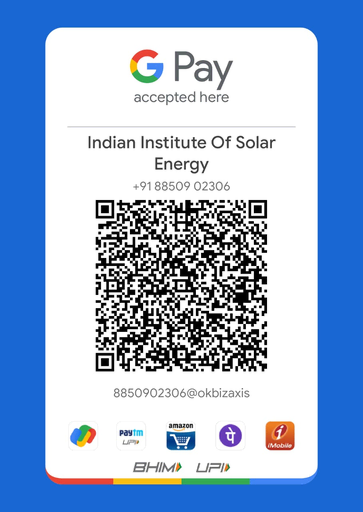
You can pay using Gpay too. Just scan the QR code below.
Diploma holders or candidates with relevant experience can join under lateral entry for the second or third year, depending on their qualifications.
Industry-aligned: Designed with inputs from industry experts to meet the demand for skilled professionals.
Multiple exit points: Students can exit with a Certificate (after 1 year), Diploma (after 2 years), or a full B.Voc degree (after 3 years).
Year 2: In-depth study of solar PV systems, hybrid technologies, and installation practices.
Year 3: Advanced topics like solar grid integration, project management, and entrepreneurship.
Each year also includes practical sessions, internships, and industry visits.
Solar PV System Designer
Installation & Maintenance Engineer
Solar Project Manager
Technical Sales Executive
Energy Auditor
Entrepreneurs starting their own solar businesses
Sustainability: Contributes to reducing the carbon footprint by promoting clean energy.
Entrepreneurship potential: Provides knowledge to start a solar business.
High demand: Solar is one of the fastest-growing industries worldwide.
Practical projects
Internship performance
Viva and presentations
Mentorship: Guidance from experienced faculty and industry professionals.
Entrepreneurship support: Help for those interested in starting their solar ventures.
Solar project planning and management
Knowledge of electrical circuits, power grids, and hybrid systems
Marketing and business skills for solar startups
Admission procedure:
Step one:
- Admission for the B Voc in Solar Technology will start from 05th October 2024.
- All the students in our inquiry database will be emailed first and given an chance to take admission on first come first basis.
- After you make the payment, you will be directed to the application page.
- Here you can submit all your details.
- Shortlisted candidates will be called for admission round.
- Admission cum course fee should be paid at this stage as per fee schedule given by IISE.